Tag: DnD

Every Type of Player You’ll Meet at a D&D Table

You’ve been playing long enough. You know them. You love them. You sometimes want to gently fold them into the dice bag and shake them around until they calm down. Every D&D table is a beautiful, chaotic ecosystem of personalities that shouldn’t work together — and yet, somehow, the adventure happens anyway. Here’s an affectionate, completely accurate field guide to the players you will absolutely find at any table, anywhere in the world, until the end of time.


The Murder Hobo

Every town is a target. Every NPC is a threat assessment. Every quest giver is one bad Persuasion roll away from becoming loot. The Murder Hobo didn’t come to your campaign to make friends — they came to see what happens when you set the tavern on fire, and honestly? They need to know.

What makes this player secretly wonderful is their commitment. They are present. They are engaged. While everyone else is debating whether to trust the mysterious hooded stranger, the Murder Hobo has already rolled initiative. Are they making the DM’s life harder? Absolutely. Are they also the reason everyone at the table is leaning forward in their chairs? Also absolutely.

You can’t stay mad at them. They once accidentally started a war between two nations and then negotiated peace using only a severed hand and a wineskin. That’s called character, and you can’t buy it.


The Rules Lawyer

Somewhere between pages 247 and 312 of the Player’s Handbook, this person found their calling. They have the rulebooks bookmarked, cross-referenced, and possibly laminated. They will cite the errata. They know about the errata. They will pause combat — mid-round, mid-dramatic-monologue — to clarify that grappling actually works differently than the DM just ruled.

Here’s the thing: you need this person. You desperately, quietly need them. The DM needs them. When the Rules Lawyer isn’t at the table, you end up in a three-hour argument about whether a Nat 20 on a death save means you get to punch a god. With them there, at least the chaos is structured.

They’re also usually the first one to use the rules for the party — catching a loophole that lets the rogue sneak attack twice, or remembering that Silvery Barbs exists right when the BBEG is about to land a killing blow. The Rules Lawyer giveth and the Rules Lawyer taketh away. Blessed be the Rules Lawyer.


The Method Actor

This player didn’t make a character. They made a person. That character has a backstory spanning forty-seven handwritten pages, a childhood trauma that took three sessions to fully unpack, a recurring nightmare about a lighthouse, and opinions about cheese. Strong opinions. In-character opinions.

They will not break character. Not for anything. If their character hates boats, they will argue with the party for twenty minutes about whether to cross the river, fully in-character, complete with a slight regional accent they’ve been workshopping since session one. The DM can see the plot waiting on the other side of that river. Everyone can see it. The Method Actor does not care.

But when their character arc finally lands — when they get that moment they’ve been building toward for months — it hits like a freight cart. Everyone goes quiet. Someone might cry. You remember exactly why you play this game. The Method Actor earned that, and so did you for suffering through the boat argument.


The Distracted Phone-Checker

They’re here. They’re excited to be here. They also just need to respond to one text, check something quickly, and — oh, a notification — and then they’re fully back. Mostly. Sort of. “Wait, whose turn is it? What happened? Did we fight someone?”

The Distracted Player is not a bad player. They’re a busy human being who genuinely loves D&D and genuinely cannot stop their brain from multitasking at all times. They will snap back to perfect focus the moment something explodes or their character is directly addressed. The rest of the time, they’re operating on vibes and recap.

Also, nine times out of ten, it’s their turn right when something critical is happening, and somehow — somehow — they make exactly the right call. “Oh, I cast Counterspell.” On what? “On whatever that was.” It works. They don’t fully know why it worked. The table cheers. They go back to their phone.


The One Who Always Has the Right Spell

You’re trapped. The bridge is out. The king is cursed. The party is arguing. And then, from across the table, in a voice of absolute calm: “I have a spell for that.” They always have a spell for that. You don’t know how. Their spell list looks like it was curated specifically for every problem your campaign has ever produced.

Speak with Animals. Tiny Hut. Leomund’s Secret Chest. Sending. They have them all prepared, every long rest, without fail. It’s either incredible foresight, meticulous optimization, or some kind of low-grade precognition. You’ve stopped asking. You’ve started just looking at them whenever things go sideways.

The DM secretly designs encounters around them. Not to counter them — just to see what happens. They always have a spell for that too.


The Chaotic Neutral Gremlin

Not to be confused with the Murder Hobo (who is goal-oriented), the Chaotic Neutral Gremlin acts purely on impulse and curiosity. What happens if I drink the mystery potion? What if I lie to the paladin about where I found the cursed amulet? What if I bet my horse in a card game with a demon? These are not rhetorical questions. They are Tuesday.

The Gremlin is powered by a deep need to find out what happens next, and they’re willing to be the catalyst. Half your best campaign stories start with something they did. Half your worst campaign stories also start with something they did. The line between “legendary session” and “three-session consequence arc” runs directly through their character sheet.

You love them. The DM has a separate notebook just for tracking their ongoing consequences. It’s a thick notebook.


The Therapist in Disguise

This player has somehow turned their Bard or Cleric into a full-time support role — not just mechanically, but emotionally. They’re tracking everyone’s character arcs. They remember the detail you mentioned in session two about your fighter’s dead brother. They set up the perfect moment for your character’s redemption without making it obvious they engineered the whole thing.

They also check in on the real humans at the table. “Hey, that scene got kind of intense — everyone okay?” They bring snacks. Good snacks. They remember that you don’t like peanuts. When the campaign ends, they’re the one who organizes the wrap-up session and makes sure every character gets a proper send-off.

If you have one of these players at your table, you keep them. You protect them. You let them know that their work is seen, because they spend a lot of time making sure everyone else feels the same way.


The One Who Disappeared for Six Sessions and Came Back

Life happens. They missed a few sessions — okay, six — and then they were back, sitting in their usual chair, picking up their dice, asking if their character had done anything cool while they were away. The answer is always “sort of” and always requires a twenty-minute explanation.

The truly impressive thing is how fast they get back up to speed. By the end of the session, they’re caught up, fully engaged, and somehow critical to the plot again. It’s like they never left. It’s also a little suspicious. You don’t question it. The table is complete again. That’s what matters.


These are your people. Every single chaotic, rules-citing, phone-checking, spell-hoarding, gremlin-brained one of them. The table wouldn’t be the same without any of them — even the one who keeps starting fires. Especially the one who keeps starting fires.

Wherever you’re playing, whatever campaign you’re running, whatever impossible situation you’ve talked yourselves into: you’re exactly where you’re supposed to be, surrounded by exactly the right weirdos.

Roll well, adventurer.
, , , , , ,

5 Things I Wish Someone Had Told Me Before My First D&D Session

I still remember sitting down at my first D&D session with a character sheet I barely understood, a set of dice I had no idea how to read, and the creeping suspicion that everyone else at the table had been born knowing the rules. Nobody had told me anything useful. Just “you’ll figure it out” and a photocopied spell list.

Years later, I’ve run dozens of campaigns and sat across from hundreds of new players. And the same confusion comes up every single time. So here’s the stuff I actually wish someone had told me.


1. Your Character Sheet Is a Cheat Sheet, Not a Test

New players treat the character sheet like an exam they haven’t studied for. They stare at it, panic, and then apologize to the table for not knowing what their “spell save DC” does in the middle of combat.

Here’s the truth: your character sheet is already telling you everything. The numbers are already calculated. When the DM says “roll to hit,” you find your attack bonus, add it to the d20, and say the number out loud. That’s it. You don’t need to know why your modifier is +5. You just need to know where it lives on the sheet.

The first two sessions, keep a finger on your main attack stat and your AC. Those two numbers are 80% of combat. Everything else you’ll learn by watching it happen.


2. The DM Is Not Trying to Kill You

This one took me embarrassingly long to internalize. The Dungeon Master is not your opponent. They’re the author of the world — they want the story to be exciting, tense, and dramatic. A great DM wants your character to almost die. They do not want your character to just die on session one from a goblin ambush because you didn’t know you could use a bonus action.

Most DMs are quietly rooting for you the entire time. If you’re doing something that would obviously get you killed, a good DM will usually give you a moment — a creaking floorboard, a smell of smoke, an NPC who looks nervous — before the trap springs. Learn to read those signals and you’ll live a lot longer.


3. Roleplaying Does Not Mean Doing a Voice

Every new player I’ve ever met thinks roleplaying means you have to perform. Do an accent. Speak in character. Commit to the bit so hard the table either loves you or cringes.

It doesn’t. Roleplaying is just making decisions as your character. When the shady merchant offers you a suspicious deal, you ask yourself: “Would my character take this?” And then you say what they’d say — even if it comes out in your completely normal voice with no accent whatsoever.

The best roleplaying moment I ever witnessed was a player who never did a voice once, but who sat quietly for ten seconds before responding to the BBEG’s monologue, and then said flatly: “My character doesn’t believe him.” The table went silent. That was it. That was great roleplaying.


4. Ask Questions Out Loud

New players spend half the session quietly confused, hoping things will make sense eventually, not wanting to slow down the table. Meanwhile the table is going to slow down anyway for snacks, for bathroom breaks, for someone’s phone call, for a twenty-minute argument about whether a door opens inward or outward.

You have permission to ask questions. “Wait, can I do that?” “What does that spell actually do?” “What do I see when I look around the room?” These are not annoying questions. These are the questions that make the game work. The DM needs you to ask them so they know what to describe next.

The players who improve fastest are always the ones who ask the most questions in their first five sessions.


5. Your Dice Don’t Have Memory — But Treat Them Like They Do

This one is purely superstitious and I stand by it completely.

Your dice do not remember that they rolled three 1s in a row. Statistically, every roll is independent. Logically, there is no such thing as a “lucky” d20.

But tabletop RPG players have been arguing about hot and cold dice since 1974 and we are not stopping now. Keep your dice in a bag. Don’t let other people touch them without permission. Roll them in a dice tray so they land flat and don’t bounce off the table in a way that counts as a 2. Have a ritual. The ritual is not real magic. It is real camaraderie.

And when your d20 rolls a natural 20 at the exact moment your character is doing something legendary, you will feel — deep in your bones — that the dice knew.


There’s nothing like that first session. Everything is confusing and electric and slightly terrifying and you don’t know what a concentration spell is and someone at the table has a voice for their character that is genuinely incredible and you think there’s no way you’ll ever be as comfortable as they look.

You will be. Faster than you think.

Roll well, adventurer.

, , , , , ,
[Top]

Best Top 5 Game Master Screens for Every Dungeon Master

The dungeon master’s screen is sacred. It’s the veil between your meticulously planned session and the chaotic, wonderful catastrophe your players will inevitably create. Behind the screen live your notes, your random tables, your secret saving throws, and that TPK you’ve been building toward for six sessions. Choosing the right screen matters more than most players realize. Here are the five best available right now.

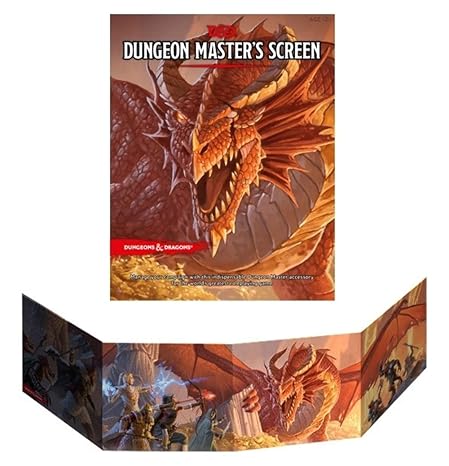
1. D&D Dungeon Master’s Screen — The Classic Wizards Accessory

The official Wizards of the Coast DM screen is a rite of passage. Every dungeon master should own one at some point. The interior panels are packed with the most-referenced 5e tables — conditions, cover rules, encounter distances, skill checks — giving you instant access to the rules that come up most often mid-session. Slim, portable, officially licensed, and genuinely useful.

  • Official Wizards of the Coast D&D product
  • Interior packed with frequently-referenced 5e tables
  • Slim landscape format — doesn’t obstruct DM-player interaction
  • Durable card construction
  • The first DM screen most players encounter

🎭 The Official WotC Screen →


2. D&D Dungeon Master’s Screen: Dungeon Kit

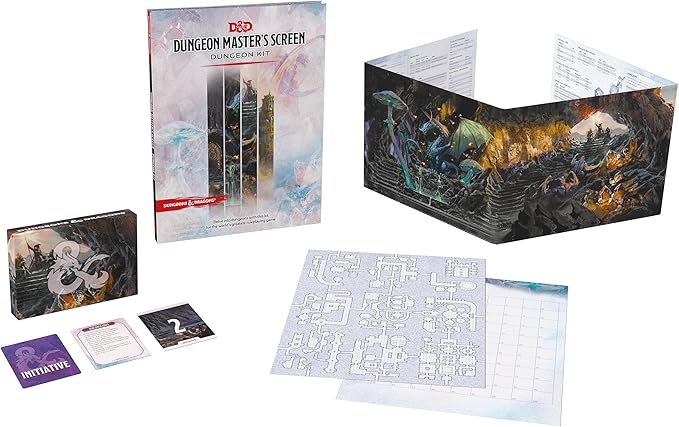
The Dungeon Kit takes the classic DM screen and upgrades it into a full dungeon-running toolkit. Alongside the screen itself, you get dungeon tiles, trackers, and extra reference material that transforms your DM workspace from a simple barrier into a fully operational command center. If you’re running dungeon-heavy campaigns, this set earns its keep every single session.

  • Includes DM screen plus dungeon tiles and trackers
  • Expanded reference content beyond the base screen
  • Great for dungeon-focused campaigns
  • Official D&D licensed content
  • Turns your DM space into a fully equipped workspace

🏰 Full Dungeon Kit →


3. CZYY DND DM Screen — Faux Leather Embossed Dragon & Mimic, 4-Panel

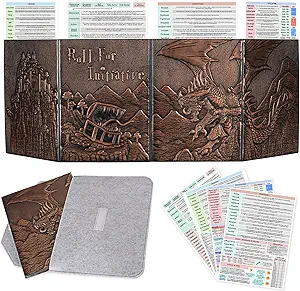
The CZYY Dragon & Mimic screen is the aesthetic upgrade your table deserves. Four panels of gorgeous faux leather with an embossed dragon on one side and a devious mimic on the other — because your players should never feel entirely safe about anything at your table. The built-in pockets let you slot in custom reference cards or notes, and the whole thing looks incredible whether open or closed on a shelf.

  • Four-panel faux leather construction
  • Embossed dragon and mimic exterior art
  • Built-in pockets for custom reference cards
  • Portrait orientation for extra height
  • Looks incredible on display between sessions

🐉 The Dragon Screen →


4. CZYY DND DM Screen — Faux Leather Embossed Cthulhu, with Inserts & Storage Case

For the DM whose campaigns drift toward cosmic horror, the CZYY Cthulhu screen sets the perfect tone before a single word is spoken. The embossed Cthulhu exterior tells your players exactly what kind of session this is. Comes with interchangeable inserts so you can customize your reference panels, plus a storage case that keeps everything organized. A premium screen for premium dread.

  • Faux leather with embossed Cthulhu exterior art
  • Includes customizable interchangeable insert panels
  • Storage case included for organization
  • Four-panel portrait orientation
  • Perfect for horror, Lovecraftian, or dark campaigns

🐙 Embrace the Cosmic Horror →


5. Hexers Game Master Screen — 4 Customizable Panels, Dry Erase Tracker

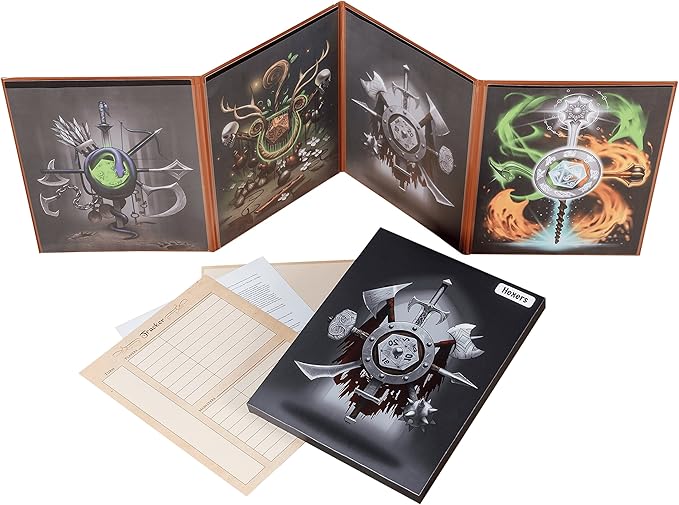
The Hexers GM Screen is the system-agnostic workhorse that belongs at every table regardless of what game you’re running. Four fully customizable panels mean you can slot in whatever reference tables serve your current system — D&D 5e, Pathfinder, Call of Cthulhu, whatever. The dry erase tracker panel is a game changer for managing initiative, conditions, and HP in real time. Practical, versatile, excellent.

  • 4 customizable panels — system agnostic
  • Dry erase tracker panel for real-time game management
  • Compatible with D&D, Pathfinder, and virtually any TTRPG
  • Insert your own custom reference cards
  • Durable construction built for regular use

🛠️ The Versatile Option →


🎁 One More Thing…

Game Master Essentials Roleplaying Starter Kit — Screen, Map Tiles, Dice & Trackers

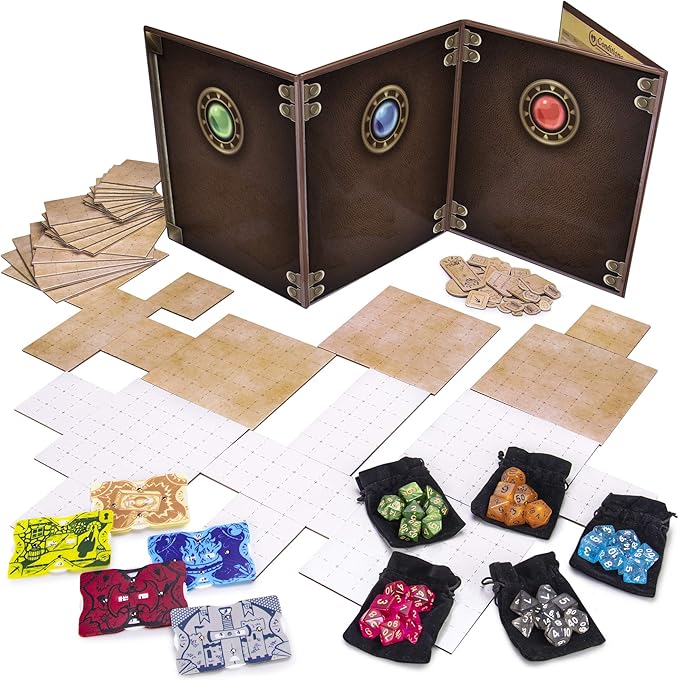
The ultimate bundle for a new DM who wants to hit the ground running. This kit packs a GM screen, 44 reversible map tiles, dice sets, and health trackers into one comprehensive package. Instead of hunting down four separate products to set up your first session, you open this box and you’re ready to run. If you know someone who wants to start DMing, this is the gift that removes every excuse.

  • Complete starter package: screen, tiles, dice, trackers
  • 44 reversible map tiles for flexible encounter design
  • Health tracker and condition reference tools
  • Dice sets included — everything in one box
  • Ideal gift for aspiring dungeon masters

🎁 The Complete Starter Kit →


Behind the screen, you are the architect of worlds. Set it up, take your seat, and let the adventure begin. Roll well, adventurer.

, , , , , , , , ,
[Top]